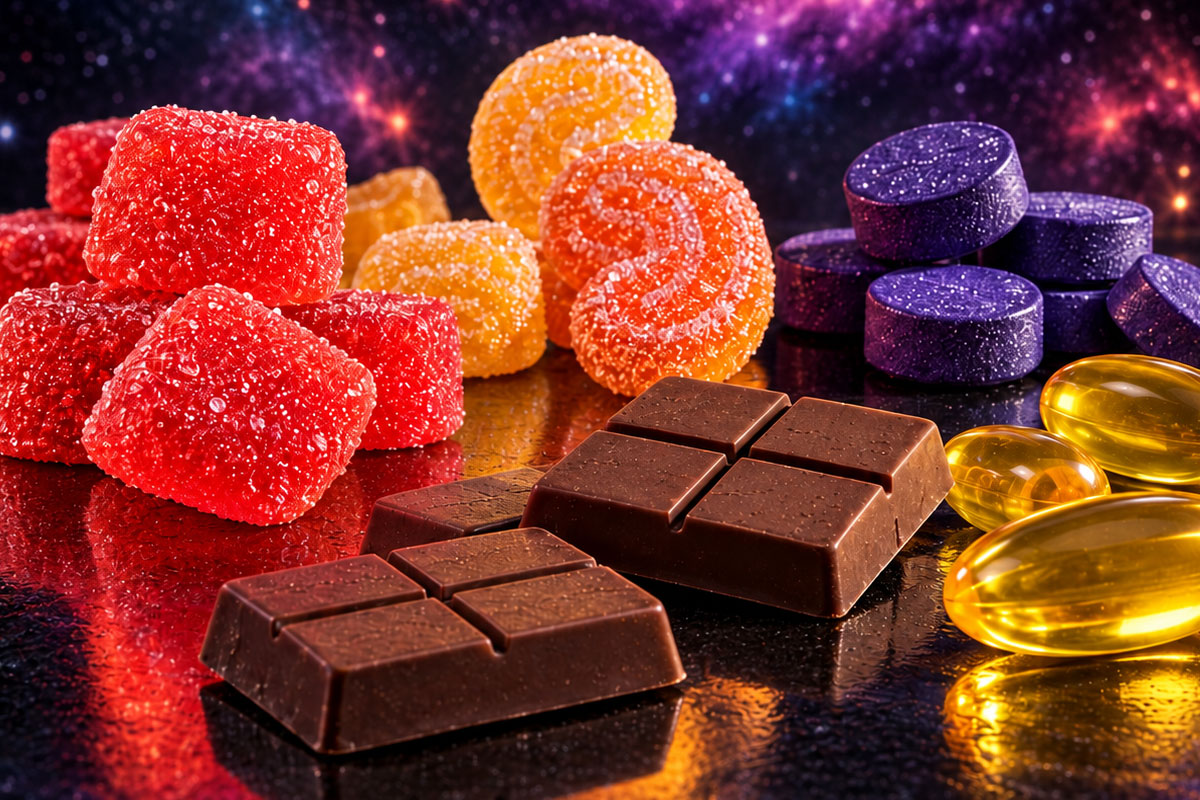
Welcome to the edible galaxy, where cannabis comes in more varieties than stars in the night sky.
Gone are the days when the edible category meant one mystery brownie and a whole lot of guesswork. Today’s regulated cannabis market offers an expanding universe of products, formats, flavours, cannabinoid combinations, and clearly labelled strengths.
But with so many options, navigating the edible aisle can feel like trying to read a map of an unfamiliar solar system.
What’s the difference between THC and CBD? Why do some products contain multiple cannabinoids? Do different edible formats work differently? And what do all those milligram numbers actually mean?
At Aces Cannabis, we’re breaking down the basics so you can better understand what’s out there and how to read the label before making a purchase.
🪐 Explore the Galaxy of Edible Formats
One of the most noticeable things about modern cannabis edibles is the variety of formats available.
Different products offer different flavours, textures, ingredients, and serving sizes, but the format alone doesn’t tell you everything about their effects.
Here are some of the common categories you’ll encounter.
Gummies and soft chews: Among the most recognizable edible formats, these come in different fruit flavours, textures, shapes, and cannabinoid formulations. They’re often divided into individual pieces with specific labelled cannabinoid amounts.
Chocolates: Cannabis-infused chocolates combine traditional confectionery formats with measured cannabinoid content. Depending on the product, they may be available in individual portions or segmented bars.
Baked goods and confectionery: Cookies, soft candies, and other food-based formats add even more variety where permitted within the regulated market.
Oils and ingestible extracts: Although not always classified as edibles, ingestible cannabis oils and related products are another oral consumption category worth understanding. Their formulation and absorption can differ from conventional food-based edibles.
The important thing to remember? Two products that look similar can have very different cannabinoid profiles and strengths.
Never judge an edible by its cosmic cover.
🤝 Meet the Cannabinoids: THC, CBD & Beyond
Cannabinoids are naturally occurring compounds found in cannabis. While the plant contains many cannabinoids, THC and CBD are the two most commonly highlighted on product labels.
THC (tetrahydrocannabinol) is the primary intoxicating cannabinoid associated with cannabis. Ingested THC can produce effects that differ in timing, intensity, and duration from inhaled cannabis.
CBD (cannabidiol) is not intoxicating in the same way as THC. CBD is available in a range of cannabis products, including formulations that also contain THC.
You may also encounter products featuring lesser-known cannabinoids such as CBN or CBG.
CBN (cannabinol) is sometimes included in multi-cannabinoid formulations. Research into its specific effects is still developing, and marketing descriptions shouldn’t be confused with proven clinical outcomes.
CBG (cannabigerol) is another naturally occurring cannabinoid being studied for its properties. Human research remains limited.
Cannabis products may contain individual cannabinoids or combinations of several compounds.
Understanding what’s inside a product is more useful than relying on catchy names or promises printed on the packaging.
💪🏻 Strengths, Ratios & Milligrams: Reading the Cosmic Coordinates
If there’s one thing every edible shopper should understand, it’s the label.
Cannabinoid content is commonly expressed in milligrams (mg), indicating how much THC, CBD, or another measured cannabinoid is present.
For example, a product labelled with 2 mg THC and 5 mg CBD per serving contains two different cannabinoids in different amounts.
A label might also describe a cannabinoid ratio, such as:
- 1:1 THC to CBD: Equal amounts of THC and CBD.
- 1:2 THC to CBD: Twice as much CBD as THC.
- CBD-dominant: A formulation with proportionally more CBD and little or no THC.
These ratios describe the ingredients, not a guaranteed type of experience.
It’s also important to distinguish milligrams per piece from milligrams per package. A package containing several portions may list both, and confusing the two can lead to unexpectedly high consumption.
In Canada, edible cannabis is generally limited to 10 mg THC per immediate container under federal regulations, although ingestible extracts can fall under different product rules.
For people new to THC edibles, public-health guidance commonly recommends starting with 2.5 mg THC or less.
Understanding these numbers helps make the product category much less mysterious.
⏳ Edible Effects: Why Timing Matters
Here’s where the edible universe gets particularly interesting.
Unlike inhaled cannabis, which enters the bloodstream through the lungs, swallowed cannabis products move through the digestive system before undergoing further processing in the body.
During this process, some THC is converted by the liver into 11-hydroxy-THC, an active metabolite that contributes to the effects of ingested cannabis.
This helps explain why edibles can feel different from inhaled cannabis, even when both contain THC.
Effects from swallowed edibles typically begin within 30 minutes to 2 hours, but it can take up to 4 hours to experience their full effects.
Those effects can last for several hours, sometimes up to 12 hours, with residual impairment potentially lasting longer.
Factors such as food intake, individual metabolism, product formulation, cannabinoid content, and personal sensitivity can all influence the experience.
Some specialized oral products may have different absorption characteristics, but faster-acting marketing claims aren’t a guarantee of an immediate or predictable response.
This is why cannabis education emphasizes starting low, allowing sufficient time for effects to develop, and avoiding additional THC while waiting.
And remember: cannabis edibles can resemble ordinary candy or food, so they should always be stored securely away from children and pets.
✨ Navigating the Edible Universe at Aces Cannabis
With so many products available, learning to compare edibles is really about understanding a few core details: the format, cannabinoid profile, potency, serving size, and product instructions.
A fruity gummy and a chocolate square might contain the same THC amount, while two nearly identical-looking gummies could have completely different cannabinoid ratios.
That’s what makes the category interesting, but it’s also why reading labels matters.
At Aces Cannabis in Hawkesbury and Alfred-Plantagenet, our team can help adult customers understand product labels, explore available formats, and compare cannabinoid information without getting lost in the galaxy of choices.
Whether you’re curious about CBD-dominant products, exploring the different kinds of THC edibles, or simply trying to make sense of the terminology, there’s always something new to learn.
The edible universe is big. A little knowledge makes it much easier to navigate.
For adults of legal purchasing age. Cannabis can impair judgment and coordination and carries health risks. Do not drive while impaired.
